
You’re out there chasing tuna, but are you sure your lure will be the one they hit first? These ten picks mimic natural prey with deadly accuracy, from feather skirts to laser etched eyes and stainless steel hooks built for speed. Some sink fast, others flash hard, and each is crafted to trigger that instant strike. Want to know which one will get you hooked up?
Fishing Trolling Lures – 6-Piece Big Game Set
https://m.media-amazon.com/images/I/81h4oUswyLL._AC_SX679_.jpg
For serious anglers targeting brute tuna, this heavy-duty option is your best bet. You get six colorful rubber lures, each 8.7 inches long and weighing 3.0 ounces, ready to troll behind your boat. They’ve got weighted metal heads for stability and PVC skirts that mimic natural swimming.
- Pre-rigged and ready: Each lure comes with a 67-inch, 400-pound test nylon line, plus reinforced 8/0 stainless steel J-hooks. No assembly needed.
- Laser-engraved eyes imitate squid to trigger strikes.
- Mixed vibrant colors adapt to changing conditions.
Plus, you get a mesh bag for storage and a 2-year warranty. It’s a professional grade set that simply works!
Factors to Consider When Choosing Lures for Tuna
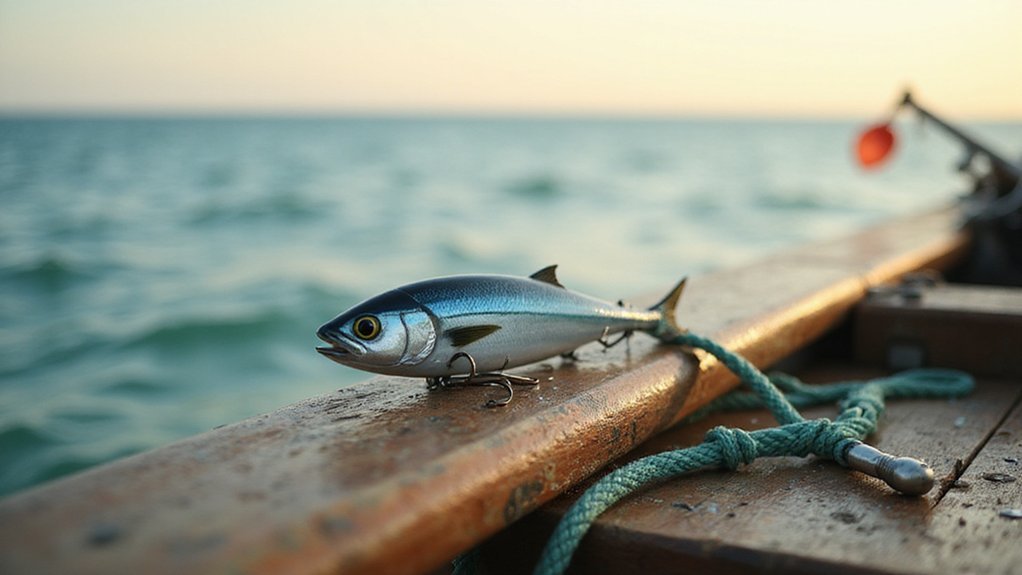
When you’re picking a lure for tuna, start with the weight selection, because you need it to match your trolling speed and reach the right depth. Hook quality matters too, so look for strong, corrosion-resistant hooks that won’t bend on a powerful strike, and consider the baitfish imitation design to make sure your lure mimics local prey. And don’t overlook color and visibility, as brighter hues often work better in choppy water, while natural tones can excel on clear days.
Lure Weight Selection
Since you’re dialing in your trolling speed, the weight of your lure becomes a critical balancing act. Go heavier, from 6 to 8 ounces, for high speed trolling; it’ll dive deeper and stay stable. For slower presentations, stick with a lighter 3 to 5 ounce lure. That keeps your offering near the surface, where tuna often cruise.
Watch out for extremes. A lure too light won’t cast far and can lose its action at speed. Too heavy, and you’ll struggle to control your boat’s pace, killing the natural movement that triggers strikes.
For most tuna scenarios, starting in the 3 to 8 ounce sweet spot works best. Adjust based on how deep you need to get and what speed feels right. Balance is everything, so match your weight to your pace. Simple as that.
Hook Quality Matters
You can’t afford weak hooks when tuna are on the line. One headshake, and a subpar hook bends out or snaps. Choose lures armed with corrosion-resistant stainless steel. Saltwater wrecks lesser metals, but this alloy holds firm trip after trip. Look for needle-point hooks, too. That sharp tip pierces a tuna’s tough mouth instantly, giving you a secure bite before the fight even starts. Reinforced, heavy-duty construction prevents bending during those long, pulsing runs. And check the gap. A properly spaced hook sets deeper, so you won’t lose a monster at the boat. A corrosion-resistant coating keeps sharpness intact for seasons of hard use. Skimp on hook quality, and you’re handing tuna the win. Invest there, and you’re ready for war.
Trolling Speed Range
A solid hook is your anchor in the fight, but it won’t matter unless the lure swims right in front of the tuna. Trolling speed makes or breaks that presentation. You’re aiming for a consistent 5 to 10 knots, which is the sweet spot for most lures. Push beyond that, and you’ll watch your favorite swimmer spin out, losing all its natural action.
But here’s the twist: high-speed lures, like the Nomad Design Madmacs, can handle speeds up to 20 knots. That’s your edge when tuna are keyed up and chasing fast. Adjust your speed based on sea conditions and the fish’s behavior. Rough water? Slow down. Tuna feeding on the surface? Crank it up. Match your pace to theirs, and you’re not just dragging gear—you’re delivering a meal. Keep it steady, keep it right, and you’ll get strikes where others draw blanks.
Baitfish Imitation Design
When tuna are dialed in on specific prey, your lure needs to match that vibe exactly. Start with realistic movement and appearance. Look for feather skirts or rubber streams that pulse naturally through the water. You’ll want sizes between 6 and 10 inches to mimic the baitfish they’re hammering. Detailed features matter: life-like eyes and textured bodies make your imitation far more convincing. Bright colors and reflective surfaces, like holographic or laser-engraved finishes, boost visibility in deeper water without going overboard. Remember, you’re not just throwing metal; you’re crafting a deception. Every detail adds up, so don’t skip the small stuff. That’s how you turn a good lure into an irresistible one.
Color and Visibility
Because tuna often hunt in low light or deep water, color can make or break your presentation. You’ll want bright, highly reflective colors like chrome blue or white in murky depths—they boost visibility and attract fish from farther away. For clear water, match natural hues that mimic baitfish like flying fish or squid; that realism triggers strikes.
In low light, go for high contrast combos. Think yellow and green or purple and black—these pop and induce aggressive bites. Luminous or glow in the dark lures also excel here, offering visibility when everything else fades.
When water’s stained, ditch subtlety. Use bold, flashy colors that cut through the mess. For clear conditions, stick with natural tones. Matching your lure’s color to the environment isn’t just smart—it’s essential. Get this right, and you’re already ahead of the pack.
Durable Construction Materials
Color and visibility set the stage for a successful presentation, but none of that matters if your lure can’t survive the first strike. Tuna hit with explosive force, so you need materials built for abuse. Go with lures forged from high-grade stainless steel or reinforced ABS plastic. They shrug off saltwater corrosion and hold up under repeated attacks.
For the head, lead or tungsten adds ballast and impact resistance, keeping your lure stable at high trolling speeds. High-quality PVC skirts resist fraying, while laser-engraved eyes won’t peel off after a few trips. And don’t skimp on hooks: stainless steel or heavy-duty J-hooks bend less, ensuring that brute force doesn’t leave you empty-handed.
- Stainless steel or ABS plastic: withstands harsh conditions
- Lead/tungsten heads: improve stability and durability
- PVC skirts + laser eyes: maintain realism and resist wear
Invest in tough gear, because tuna don’t give second chances.
Rigging and Leader Strength
Even with a tough lure in hand, your whole setup can fall apart if the rigging and leader don’t match the fight. You need leader strength of at least 150 lb to handle those powerful strikes without snapping. Go with a heavy-duty stainless steel or fluorocarbon leader; it’ll prevent abrasion from sharp teeth and rough scales. Keep the leader length between 20 and 50 feet, so your bait moves naturally and stays less visible. Connect everything with strong knots, like king hitches or Palomar knots, for durability. And don’t forget the hardware: use nylon-coated split rings and corrosion-resistant swivels. These components prevent failure during those vigorous fights. Rig it right, and you’re set for the battle.
Size for Target Species
Two key factors drive your lure size decision: the target tuna species and the baitfish they’re feeding on. For Bluefin or Yellowfin, you’ll want bigger hardware. Stick with lures in the 6 to 9-inch range; that’s your sweet spot for these hefty predators. Tuna naturally chase baitfish around 4 to 8 inches, so matching that profile triggers more strikes. Oversized or undersized lures? They’ll often get ignored, plain and simple.
For offshore or deep-sea trips, go heavier and larger. That bulk mimics the big, slow-moving baitfish you’ll find out there, making it look like an easy meal. Quick rule of thumb:
- Bluefin: lean toward 8 to 9 inches.
- Yellowfin: 6 to 7 inches works well.
Match the size to their menu, and you’re in business.
